TELUS PAI
AI-powered PRD tool for TELUS product teams.
Team: Adrian De Guzman, Matthew Au, & Jessie Reyes
Role: Product Designer, Manager
Software: Figma
Duration: February 22, 2025 - March 5, 2025
Role: Product Designer, Manager
Software: Figma
Duration: February 22, 2025 - March 5, 2025
With PAI, we aim to improve how product teams at TELUS communicate and align on product requirements and processes.
PAI is a centralized hub for PRD creation powered by TELUS' Fuel iX and team-driven intelligence to help product teams collaborate more effectively, maintain PRD consistency, and centralize past knowledge.
PAI is a centralized hub for PRD creation powered by TELUS' Fuel iX and team-driven intelligence to help product teams collaborate more effectively, maintain PRD consistency, and centralize past knowledge.

What's the issue?
How might we improve the way product teams at TELUS align on and communicate product requirements and processes?
The reality?
Collaboration is messy
Creating product requirements is a drawn-out process. TELUS PMs shared that aligning cross-functional needs involves constant back-and-forth. Inconsistent engagement across teams often leads to misalignment, delays, and frequent revisions.
Consistency is lacking
Without standardization, requirements are often unclear or incomplete. 280 Group found that 47.2% of 890 PMs reported inconsistency in documentation. Our survey showed 60% of TELUS PMs felt unconfident about the clarity and completeness of their own requirements.
Knowledge is scattered
Teams use multiple platforms to define requirements, causing key information to become disorganized or lost. As a result, 100% of TELUS PMs in our survey, reported knowledge gaps as a major issue—leading to overlooked edge cases and project delays.
The reality?
Collaboration is messy
Creating product requirements is a drawn-out process. TELUS PMs shared that aligning cross-functional needs involves constant back-and-forth. Inconsistent engagement across teams often leads to misalignment, delays, and frequent revisions.
Consistency is lacking
Without standardization, requirements are often unclear or incomplete. 280 Group found that 47.2% of 890 PMs reported inconsistency in documentation. Our survey showed 60% of TELUS PMs felt unconfident about the clarity and completeness of their own requirements.
Knowledge is scattered
Teams use multiple platforms to define requirements, causing key information to become disorganized or lost. As a result, 100% of TELUS PMs in our survey, reported knowledge gaps as a major issue—leading to overlooked edge cases and project delays.
Three key needs:
1)
Collaboration
Collaboration
PRD Processes should involve stakeholders from the start to minimize delays and ensure real-time input
2)
Consistency
Consistency
Clear, structured PRDs to keep aligned, reducing miscommunication and speeding up product time-to-market
3)
Centralized
Knowledge
Centralized
Knowledge
Reliable source of past PRDs to maintain consistency, improve visibility, and uncover knowledge gaps
Did you know?
Microsoft and LinkedIn say that 75% of knowledge workers already use AI and additionally, 35000 TELUS employees already use Fuel iX, TELUS generative AI
How does it work?
1)
Manually drafting PRDs from scratch
Manually drafting PRDs from scratch
✔ AI-assisted PRD creation powered by TELUS' Fuel IX Gen-AI
2)
Lack of a standardized approach
Lack of a standardized approach
✔ A trainable AI model that upholds team standards
3)
Scattered PRD workflows across multiple tools
Scattered PRD workflows across multiple tools
✔ PRD creation and stakeholder collabo
-ration centralized
-ration centralized
The design process:
Secondary research
We started by conducting secondary research to understand the market size, current solutions, and the problem more holistically.
Primary research
Eventually, we cold messaged 100+ TELUS PM's through LinkedIn inquiring to participate in our user survey and interviews - reaching 6 in total.
We started by conducting secondary research to understand the market size, current solutions, and the problem more holistically.
Primary research
Eventually, we cold messaged 100+ TELUS PM's through LinkedIn inquiring to participate in our user survey and interviews - reaching 6 in total.
Consultation
Given our insights, we curated various solutions and held consultations with one TELUS PM for feedback and ensured it answered their needs.
Prioritization
With the feedback, we conducted cost-benefit analysis on our solutions and weighed our best options, followed by a prioritization framework to see which features we wanted to include in our minimum viable product.
Consultation
Given our insights, we curated various solutions and held consultations with one TELUS PM for feedback and ensured it answered their needs.
Prioritization
With the feedback, we conducted cost-benefit analysis on our solutions and weighed our best options, followed by a prioritization framework to see which features we wanted to include in our minimum viable product.
Wireframing
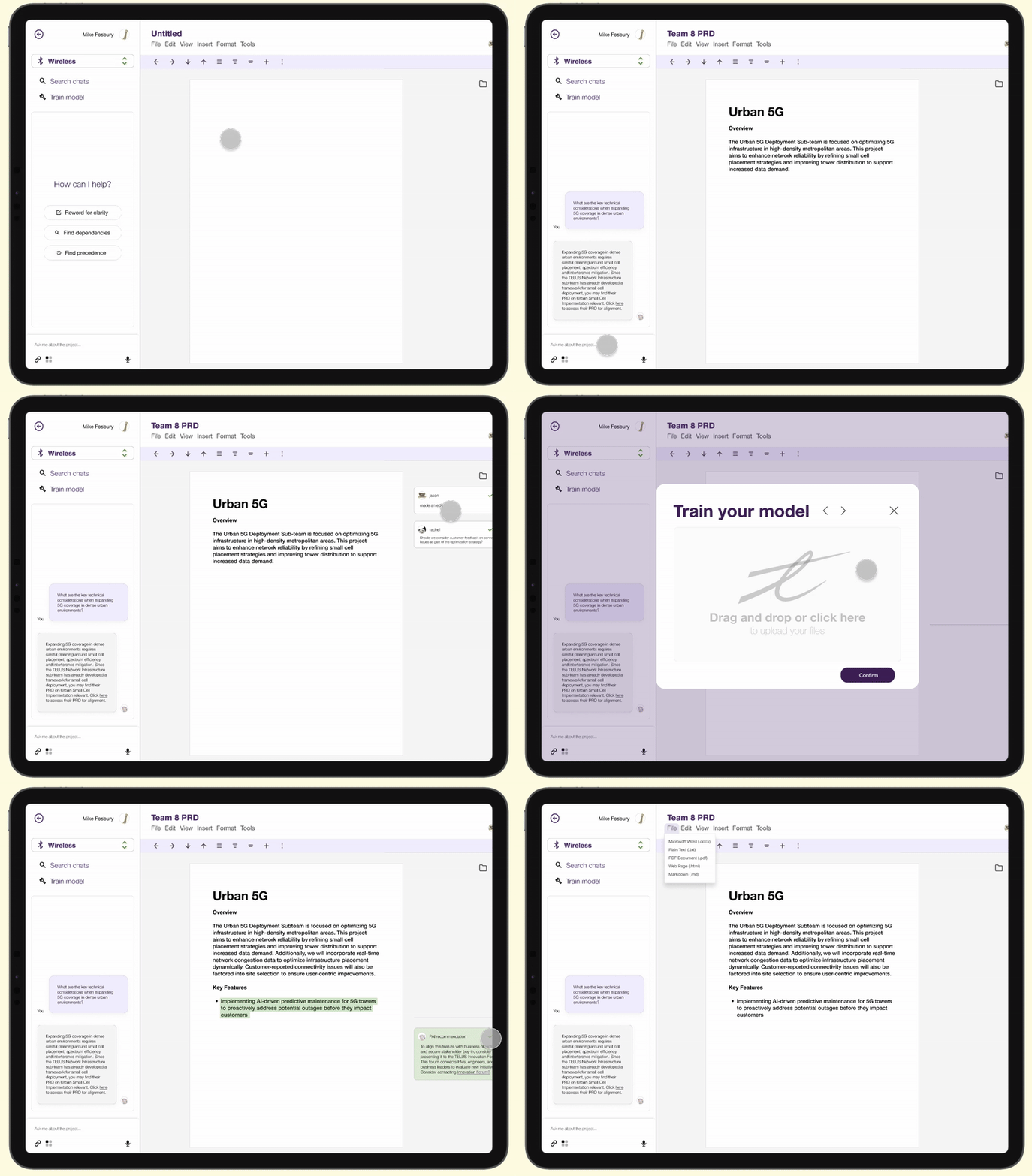
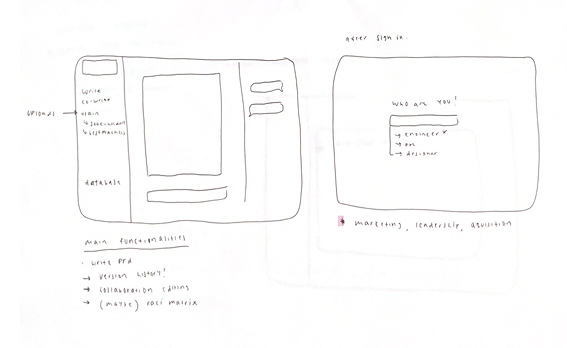
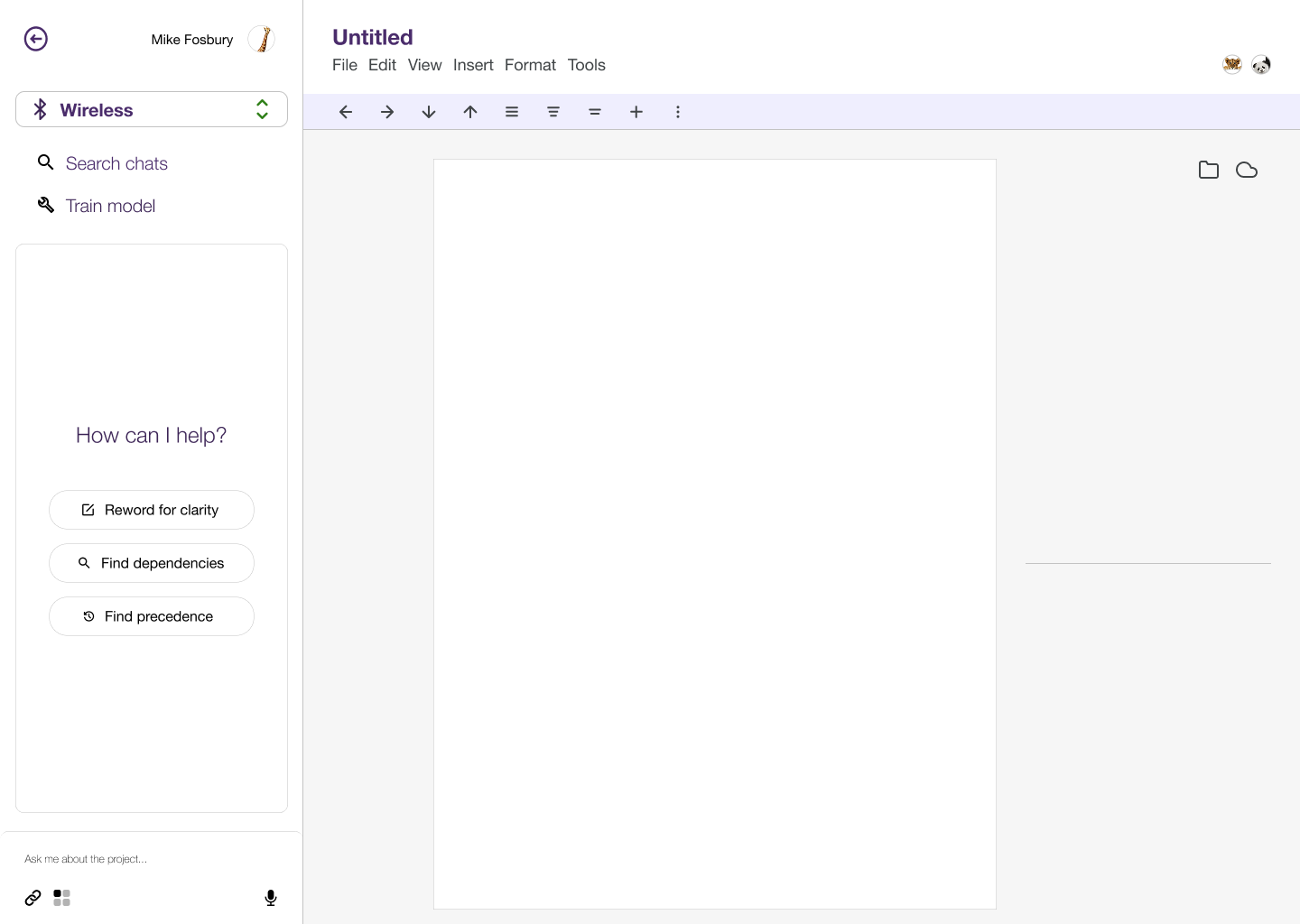
We sketched the required features, drawing inspiration from TELUS' existing platforms to foster cultural buy-in to ensure adoption and made sure to continuously iterate from low- to high-fidelity wireframes.
We sketched the required features, drawing inspiration from TELUS' existing platforms to foster cultural buy-in to ensure adoption and made sure to continuously iterate from low- to high-fidelity wireframes.
Low-fidelity
Mid-fidelity
.png)
High-fidelity
Some considerations...
Design system
While we could not access the current universal TELUS design system, we found an outdated version online and made revisions based on their website today.
While we could not access the current universal TELUS design system, we found an outdated version online and made revisions based on their website today.
1)
Key insight
Key insight
Users were uncertain in what to prompt the AI-assistant and training model
Usability testing
Unfortunately, due to time constraints, we had to conveniently sample our 2 friends and asked them to provide any usability feedback.
Unfortunately, due to time constraints, we had to conveniently sample our 2 friends and asked them to provide any usability feedback.
Before iteration
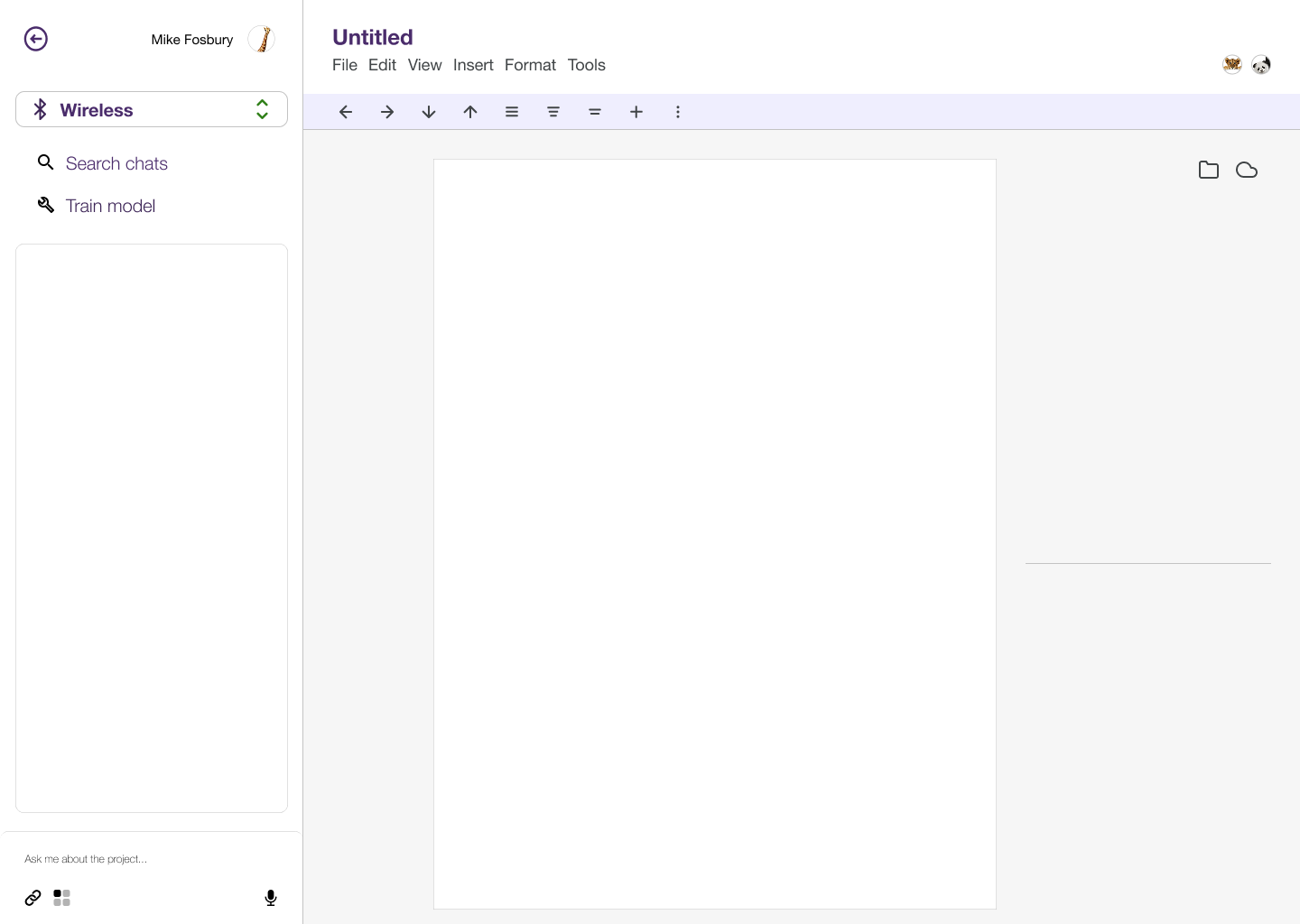
After iteration

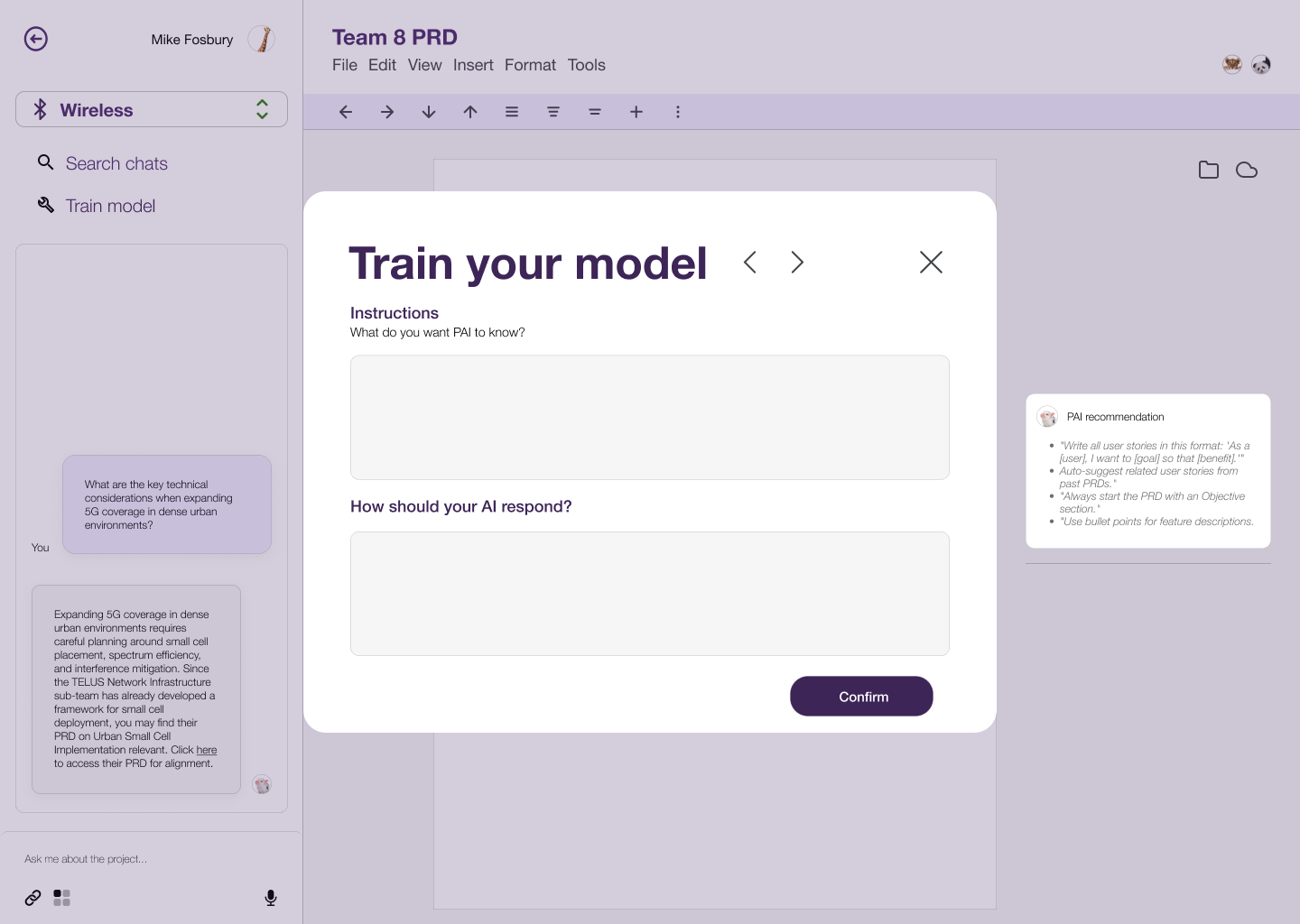
Prompting
Refined the training model and AI-assistant by integrating example prompts to streamline user onboarding and highlight key use cases.
Refined the training model and AI-assistant by integrating example prompts to streamline user onboarding and highlight key use cases.
The finished product:
Objective and key results:
1)
Improved consistency
Improved consistency
Achieve a 80% satisfaction rate among PMs regarding AI-driven suggestions for PRD improvements
2)
Increased efficiency
Increased efficiency
- Reduce time spent drafting RPDs by 50%
- Reach 60% adoption across TELUS product teams within the first year
- Reach 60% adoption across TELUS product teams within the first year
3)
Continuous AI learning
Continuous AI learning
Train the AI on at least 500 historical PRDs within the first six months
Some things I learned!
User interviews
I learned the importance of reaching out and gained valuable insights from product managers to better understand their user needs.
Planning deliverables
Setting realistic deliverables were key in keeping us all on track for this constrained, time-intensive project.
Creating components
Gained a better grasp on button components and look forward to better applying this knowledge in future projects!
I learned the importance of reaching out and gained valuable insights from product managers to better understand their user needs.
Planning deliverables
Setting realistic deliverables were key in keeping us all on track for this constrained, time-intensive project.
Creating components
Gained a better grasp on button components and look forward to better applying this knowledge in future projects!
See ya! Have an awesome day :)